
Gold Deposits Of South Africa.
South Africa Is known to have the world’s most richest and deepest gold mines in the world, making gold deposits of South Africa the most sought after mining jurisdiction Many regions of the world has fervently searched for gold at one or another stage of their existence.
We can mention the fabled city of Eldorado, where many a men searched for gold, without much success. Can we not therefore conclude that the elusive Eldorado was found in South Africa?.
Gold deposits in South Africa are found in higher concentrations and economic values in the area known as the Witwatersrand basin.
The Witwatersrand basin is a 300 kilometre (186.4 miles) long, and 160 kilometre (99.4 miles) wide, elliptically shaped geological formation in the high veld region of South Africa.
Where Are The Deposits Of Gold Found In South Africa.
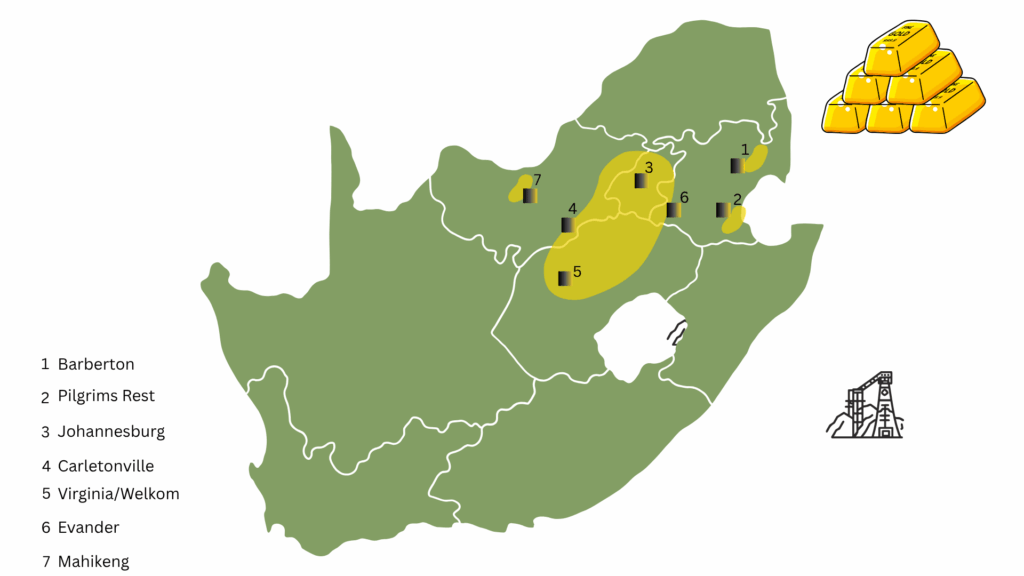
1. The Greenstone Belt.
The area in the then Transvaal, called Barberton, experienced the first wave of prospectors in South Africa. Barberton is built in and around the Makhonjwa mountains, a UNESCO World Heritage site. Fortune seekers were exploiting the quartz pebbles rock found in the vicinity of the town.
2. The Beta Reef.
The second place was in the mountains of the town called Pilgrims Rest. It is worth noting that the towns were proclaimed after the authorities determined that there was enough gold deposits to declare the areas as a public diggings for gold, or if the area is declared a goldfield.
3. The Main Reef.
The biggest find of gold in the world was done by the prospectors George Harrison and George Walker on the farm Langlaagte. The Langlaagte discovery led directly to the founding of the city of Johannesburg, the volume of the gold extracted in the Witwatersrand basin is the highest in the world. Mines in the Johannesburg area were mining the northern section of the Witwatersrand basin.
4. Carbon Leader Reef And Venterdorp Contact Reef.
The south western section of the witwatersrand basin was intersected in the area where Carletonville is built.
5. Basal Reef.
The place where the highest tonnage of ground was moved in the mining operations in South Africa is in the southern section of the Witwatersrand basin. Allan Roberts searched and proved the location of this gold bearing quartz pebble conglomerates by sinking a borehole at the farm Zoeten-Inval, on the sub-division called Aandenk. The town of Allanridge was founded and named in his honour. This discovery led directly to the founding of the towns of Allanridge, Virginia, Hennenman and the city of Welkom.
6. Kimberly Reef.
Evander gold mines are exploiting the reef known as the Kimberly reef. This is the eastern side of the Witwatersrand basin.
7. Kraaipan Grenstone Belt.
Kalgold mine, located 55 kilometres (34 miles) from Mahikeng in the north west province, mines it’s gold not from a traditional reef, but from an orebody within a banded iron-ore formation. It is currently the only open cast mine being operated as a large scale mining operation in South Africa.
How Did The Deposits Get To Be Located There Where They Are Found.
There are two leading hypothesis about how did the gold find it’s way in that part of the world in higher concentrations than anywhere in the world.
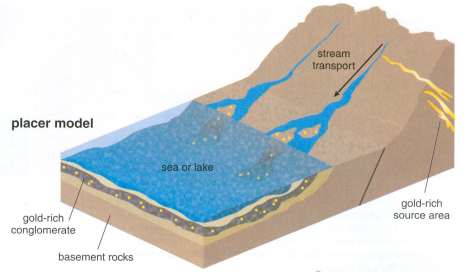
The Placer Model.
Everyone agrees that the sediments
of the Witwatersrand were originally carried in by a system of braided rivers
that eroded material from the surrounding highlands and deposited clay, sand and gravel at the edge of an
inland sea (or possibly a great lake). As
the rivers emptied into this vast body of water, heavier sediments, such as
large quartz pebbles and heavy minerals, settled first, building gravel-rich deltas close to the shoreline, whereas sand and clay were carried farther out to greater depths.
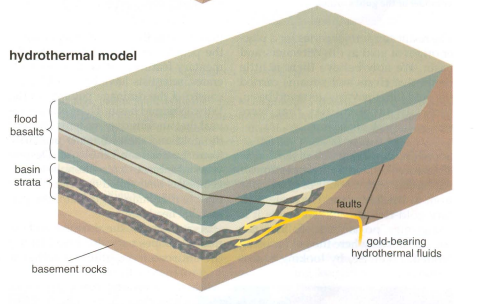
The Hydrothermal Model.
The hydrothermal model states that the sediments that washed into the basin contained very little or no gold. Instead, gold-rich hot fluids emanating from deep within the Earth’s crust, and
traveling along faults and fractures, added gold to the basin long after the sediments consolidated into rock. The gold precipitated from these fluids along chemically favourable horizons within the basin, corresponding to the layers of conglomerate.